
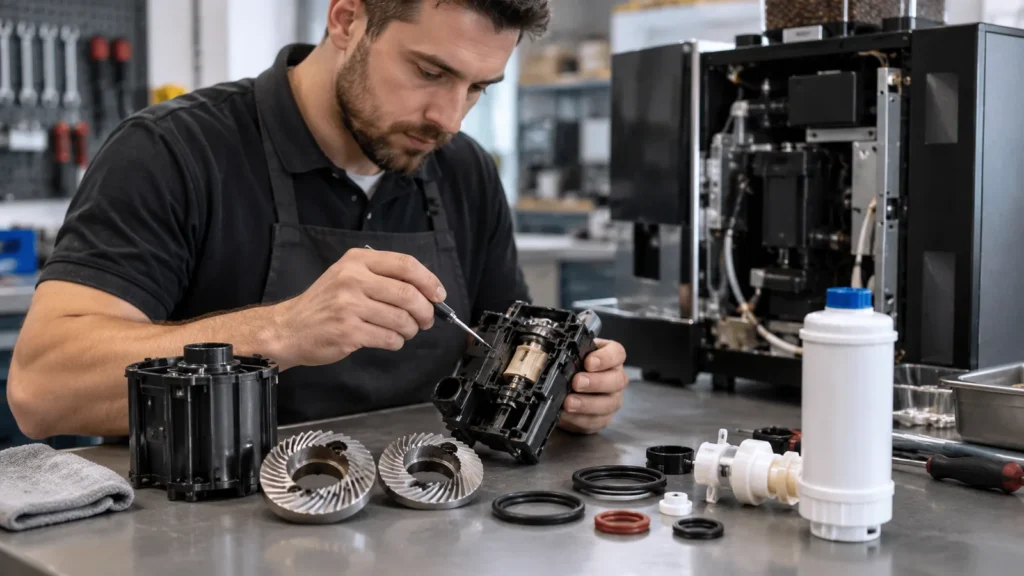
Four parts of a commercial coffee machine cause most of the faults and most of the flavour problems: the brew group, the grinder burrs, the milk system and the water filter. Panica Coffee services commercial superautomatic coffee machines across Melbourne from a workshop in Caulfield South, and this guide explains what each part does, how it fails, and which jobs belong to your team rather than a technician.
The brew group
The brew group is where ground coffee is compressed and hot water is forced through it. It is the heart of the machine and the part most affected by daily use, because coffee oils and fine grounds build up on every surface it touches.
When a brew group is neglected the symptoms are gradual: the coffee tastes increasingly bitter or stale, then extraction times drift. On many machines the brew group is removable and rinsed as part of the routine, which is the single most useful thing an office can do for its coffee.
Grinder burrs
Burrs are the two toothed discs that cut the beans to a consistent size. They wear gradually rather than failing outright, and as they dull the grind becomes less even, which shows up as weak or inconsistent coffee that no amount of adjustment fixes.
Very dark, oily beans accelerate wear and clog the chute, which is one practical reason we steer offices towards a medium roast for an automatic machine.
Coffee tasting worse than it used to? Panica Coffee can tell you whether it is the beans, the water, the cleaning routine or a part that has reached the end of its life, rather than guessing at it.
The milk system
The milk system covers the container, the line, the frother and the valves that carry milk through the machine. It is the part that causes the most avoidable service calls, because milk residue in a warm line becomes a blockage quickly.
Most machines run an automatic rinse after each milk drink, but a rinse is not a clean. The container and line still need the daily routine set out in our two minute daily cleaning guide, and plant milks need particular attention, as our oat milk guide explains.
The water filter
The filter protects everything downstream of it. Melbourne water is relatively soft, but it still carries minerals that form scale on the heating element and inside the brew path, and scale is the most common reason a commercial machine loses temperature stability.
Filters are rated by volume rather than by time, so the replacement interval follows how much water the machine uses. Our guide to water filtration covers how to work that out.
Seals, gaskets and the drip tray
Seals and gaskets are cheap parts that perish with heat and time. A leak at the brew group or a drip that appears overnight usually means a perished seal rather than anything serious, provided it is dealt with early.
The drip tray and grounds drawer are not really failure points, but a drawer emptied late is the most common cause of a machine refusing to run.
Which jobs belong to your team, and which do not
Your team handles the daily routine: milk container, grounds drawer, drip tray, and the rinse cycles the machine prompts for. That is it.
Descaling, brew group servicing, burr replacement and anything requiring the machine to be opened belong to a technician. Commercial machines run at pressure and temperature, and there is no useful saving in attempting those in an office kitchen. Under a Panica Coffee rental those jobs are included, as set out in what is included in an office coffee machine service plan.
Need Help With Your Coffee Machine?
Tell Panica Coffee what machine you have and what it is doing. We service commercial superautomatic machines across Melbourne and can tell you whether it needs a part, a service or just a better cleaning routine. Call 1300 529 505 or use the form below.
From the Panica shop: coffee machine spare parts.
Frequently Asked Questions
Q1: Which coffee machine part fails most often? The milk system, because milk residue in a warm line blocks quickly. Most of those calls are preventable with the daily clean.
Q2: How often do grinder burrs need replacing? It depends on volume and on the beans rather than on a set period. Dull burrs show up as uneven grind and weak coffee that adjustment does not fix.
Q3: Can we clean the brew group ourselves? On many machines the brew group is removable and rinsing it is part of the routine. Anything beyond rinsing belongs to a technician.
Q4: How often should the water filter be changed? By volume of water used rather than by the calendar. A busy machine reaches the limit sooner than a quiet one.
Q5: Is it worth repairing an older commercial machine? Usually, if it still suits your volume. Replace it when the machine is the wrong size for the office it now serves, since servicing cannot fix a capacity mismatch.
Machine Not Performing?
Tell Panica Coffee the symptoms and the machine, and we will tell you what it needs. Call 1300 529 505.