
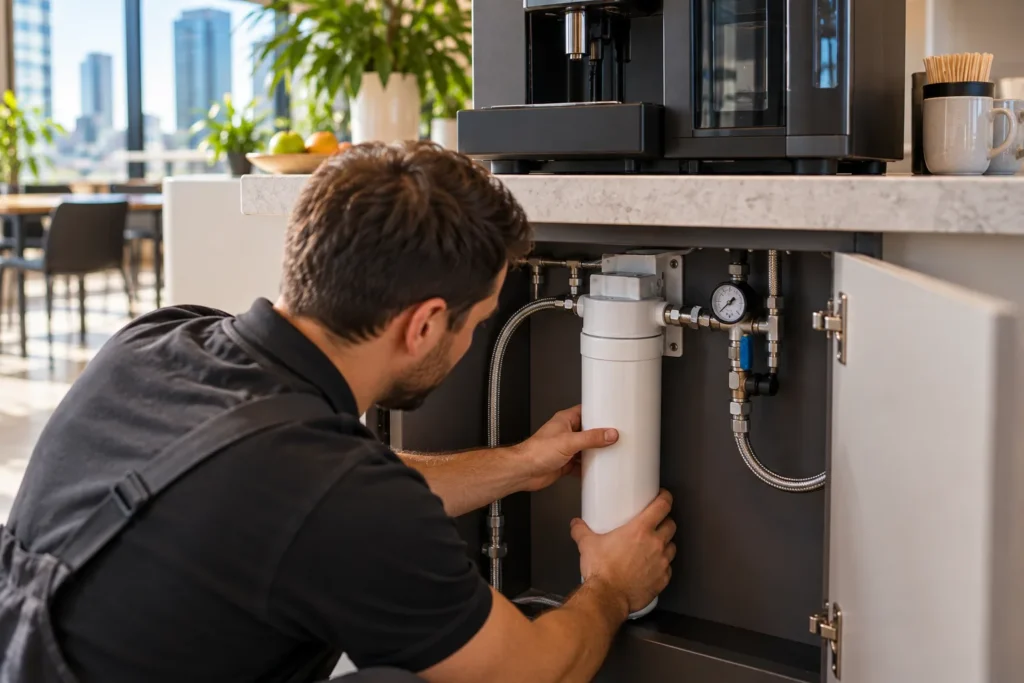
Melbourne has some of the softest tap water in Australia. Because of that, plenty of office managers assume a filter on the coffee machine is an optional extra. However, water remains the single biggest cause of the commercial machine faults our technicians attend, and soft water brings problems of its own.
Why soft water is not the same as safe water
Melbourne’s supply comes largely from protected forest catchments, so it arrives low in dissolved minerals. That is genuinely good news for limescale. Nevertheless, three things still cause trouble. If you have not decided between a tank and a mains connection yet, see our guide to office coffee machine plumbing.
First, heating concentrates whatever minerals are present. Even soft water leaves deposits on a boiler element after years of daily use.
Second, very low mineral content is not ideal for coffee. Minerals carry flavour, so water that is close to pure tends to extract flat and thin. Baristas usually describe the result as hollow.
Third, chlorine is added at the treatment stage for safety. It does its job in the pipes, but it survives to your tap, and once concentrated in an espresso it tastes of swimming pool.
What limescale actually does to a machine
Scale builds on the hottest surfaces first, which means the heating element and the boiler walls. Because it insulates, the element works harder and longer to reach temperature. Therefore energy use climbs and brew temperature becomes unstable.
Left alone, scale narrows internal pipework and jams solenoid valves. At that point you are looking at a callout, replacement parts, and a machine out of action during the morning rush.
The repair bill is rarely the worst part. A machine down for two days in a fifty person office is the part people remember.
The three jobs a filter does
- Carbon filtration removes chlorine and improves taste. This is the change most people notice immediately.
- Scale management either removes hardness minerals by ion exchange, or holds them in suspension so they cannot bond to hot metal.
- Sediment filtration catches rust and pipe debris, which matters in older Melbourne buildings with aged plumbing.
Choosing the right filter for your site
For most Melbourne offices on mains supply, a combined carbon and scale inhibitor cartridge is enough. Given how soft the supply already is, full softening is usually unnecessary and can strip out more mineral content than the coffee wants.
Cafes and high volume sites are a different case. Once you pass roughly two hundred coffees a day, or if the building runs on tank or bore supply, a water test before choosing is worth the small cost.
How often the filter needs changing
Filters are rated in litres, not months. Consequently a busy site can exhaust a cartridge in a quarter of the time a small office takes.
- Under 15 staff: usually about once a year
- 15 to 50 staff: every six to nine months
- 50 plus, or a cafe: every three to six months
Since the rating is volumetric, the honest answer is that your supplier should track it against real usage rather than guessing from a calendar.
Signs the filter is overdue
- Coffee tastes flat, or faintly of chlorine
- The machine takes noticeably longer to heat up
- Flow rate drops or the pour looks uneven
- Temperature errors appear more often
- White crust forms around the group head or steam wand
Scale that gets past the filter eventually shows up as a fault. Our guide to common commercial coffee machine faults explains what a descale lockout means and when the machine needs a technician.
How this works with a Panica rental
On our rental machines, filtration and filter changes sit inside the scheduled service rather than arriving as a separate invoice. Because we track each machine’s volume, cartridges get replaced on usage rather than on a guess. If you own your machine instead, we can service it and supply cartridges on the same schedule.
From the Panica shop: water filters.
Frequently asked questions
Does Melbourne water really need filtering for a coffee machine?
Yes, although less aggressively than in harder water cities. Chlorine removal and mild scale control matter here more than heavy softening.
Can I just use a jug filter and fill the tank?
For a small pour over setup, possibly. For a plumbed commercial machine it is not practical, and jug filters do little for scale.
What happens if the filter is never changed?
An exhausted cartridge stops working rather than warning you. Scale then builds quietly until flow drops or the machine fails.
Will filtered water change how the coffee tastes?
Usually yes, and quickly. Removing chlorine tends to be the most obvious improvement.
Talk to us about your setup
If your machine is slowing down, tasting off, or you simply cannot remember the last filter change, we can check it. Call 1300 529 505 or send us a message and we will tell you what your machine needs.
Filtration slows scale, it does not replace the daily cleaning routine your team runs at the end of each day.