
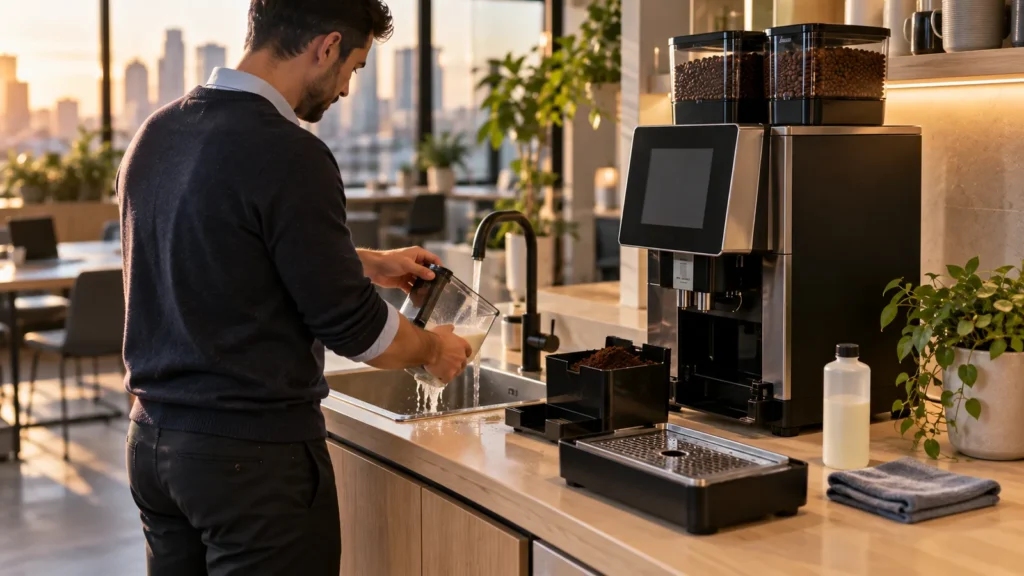
A commercial superautomatic coffee machine needs about two minutes of attention a day, and the workplaces that give it those two minutes almost never call us about milk faults. Panica Coffee has serviced commercial superautomatic coffee machines across Melbourne since 2017, and the single clearest pattern is this: the machine is rarely the problem, the daily clean is.
A superautomatic coffee machine grinds, brews and textures milk at one button press, so no barista training is needed. The trade off is that milk, coffee oil and water residue all pass through the same machine every day, and they leave deposits that build up quietly until the coffee turns bitter or the milk stops frothing.
Plant milk makes that daily rinse matter even more, because its sugars bake onto a warm milk line. Our guide to oat milk in office coffee machines covers the difference.
What does a daily office coffee machine clean actually involve?
Two minutes, at the end of the day, on three parts. Run the machine’s own milk rinse cycle, empty and rinse the milk container, and empty the grounds drawer and drip tray. That is the whole daily routine on most bean to cup machines in Melbourne offices.
- Milk rinse, about 30 seconds. Every superautomatic has an automatic milk rinse. Run it after the last coffee of the day, not the first of the morning, so milk does not sit in the lines overnight.
- Milk container, about 45 seconds. Tip out what is left, rinse with warm water, and put it in the fridge or leave it dry. Milk left at room temperature overnight is the most common cause of a service call that was avoidable.
- Grounds drawer and drip tray, about 45 seconds. A 30 person office fills the grounds drawer roughly every 60 to 80 coffees. Left full, the machine stops mid cycle at the worst possible time, usually 9am.
Who should own the daily clean in an office?
One named person on a roster, not the whole team. In every Melbourne workplace where cleaning is “everyone’s job”, it becomes nobody’s job within a fortnight. Put a name against each day of the week, stick the list on the cupboard above the machine, and rotate monthly.
In coworking spaces the answer is different, because members come and go. There the clean belongs to the operations or front of house staff, which is one reason coworking coffee machine rental works differently to a private office.
What needs doing weekly and monthly?
- Weekly: run the machine’s cleaning tablet cycle for the brew group, and wash the milk lines with a dedicated milk system cleaner. Ten minutes, once a week.
- Monthly: wipe the bean hopper dry, check the water filter indicator, and look at the drip tray seal for splits.
- Quarterly or by usage: descaling and filter changes, which are handled by a technician under a service plan rather than by your staff. Melbourne water is moderately hard, so scale builds steadily.
The split matters. Daily and weekly tasks belong to your team. Descaling, group head seals, milk system servicing and repairs belong to us, and they are set out in what is included in an office coffee machine service plan.
What happens when the daily clean gets skipped?
Three things, in a predictable order. First the coffee tastes bitter, because old coffee oil in the brew group turns rancid. Then the milk stops texturing properly, because dried milk narrows the lines. Then the machine throws an error and stops, usually with a queue in front of it.
None of that is a machine fault, and all of it costs a callout. Panica Coffee responds within 4–24 hours from the Caulfield South workshop and carries parts for the brands we install, so most faults are fixed on the first visit, but a fault avoided is cheaper than a fault fixed.
Skipped cleaning is behind a good share of callouts. See what to check when a commercial coffee machine stops working for the faults that a proper clean often resolves on its own.
How long does the whole routine take across a week?
About 20 minutes. Two minutes a day across five days, plus a ten minute weekly clean. For a 30 person office pulling 150 to 300 cups a week, that is roughly four seconds of cleaning per coffee served.
Frequently asked questions
Can I use dish soap on the milk container?
Yes, warm water and a small amount of dish soap is fine for the milk container and drip tray, then rinse thoroughly. Do not put milk lines or the brew group through a dishwasher unless the manufacturer states it is dishwasher safe.
Do I still need descaling if the machine has a water filter?
Yes, though less often. A filter reduces scale, it does not eliminate it. Filters need changing on schedule, which is covered in our guide to water filtration for commercial coffee machines.
How often should a rented machine be professionally serviced?
On a schedule set by cup volume, and on a Panica Coffee rental that servicing is included rather than billed per visit. Rental starts at $35 per week ex GST with zero upfront cost.
What is the one habit that prevents the most faults?
Running the milk rinse at the end of the day rather than the start. It takes 30 seconds and it is the difference between milk residue sitting in the lines for 14 hours or none at all.
Want the machine looked after for you?
Panica Coffee rents, sells, services and repairs commercial superautomatic coffee machines for workplaces across Melbourne, from the Caulfield South workshop, with a 4–24 hour response. If your machine is playing up, book a technician through service or repair. If you are weighing up a new setup, start on the coffee machine rental page or ask us below.