
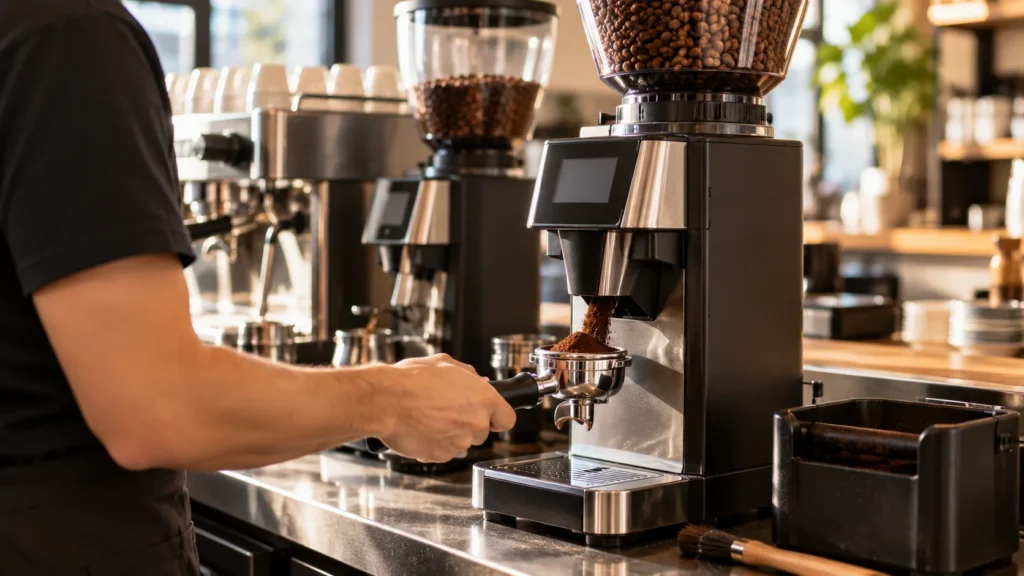
A commercial coffee grinder does more to the taste of an espresso than most people expect. The espresso machine controls water temperature and pressure, but the grinder decides how evenly the coffee is ground, how much lands in the basket and how fresh it is when it gets there. Choose the wrong grinder and even a good machine will pour inconsistent shots, run slowly through a rush or wear out its burrs far earlier than planned.
Panica Coffee sells and services commercial grinders from our workshop in Caulfield South, and has worked on coffee equipment since 2017. This guide covers the decisions that matter when choosing a commercial coffee grinder: dosing type, burrs, capacity, maintenance and how the grinder fits the rest of your setup.
What Makes a Grinder Suitable for Commercial Use?
A commercial grinder is built to grind for hours a day without overheating, drifting off its setting or slowing the service. A home grinder may make excellent coffee, but it is usually designed for a few doses a day rather than a steady queue. The differences show up in four places:
- Burr size and motor. Larger burrs and stronger motors grind faster and stay cooler. Commercial espresso grinders commonly use burrs from around 60 mm to 85 mm or larger.
- Heat management. Grinding generates heat, and hot burrs change the grind. Many commercial models have fans or cooling systems. The Fiorenzato F64 EVO, for example, uses an automatic fan that switches on as the motor warms.
- Hopper capacity. A larger hopper means fewer refills during service. The Mahlkönig E80W GbS has a 1.8 kg hopper, while many café grinders sit around 1.2 to 1.5 kg.
- Serviceability. Burrs wear, chutes clog and parts need replacing. A commercial grinder should allow cleaning and burr changes without a full strip down.
Grinders also differ by job. Espresso grinders deliver small, precise doses into a portafilter. Shop or bag grinders, such as the Mahlkönig EK43 with its 98 mm burrs and bag holder, grind larger amounts for filter or retail. Many venues need both.
Not sure which grinder suits your coffee setup? Tell Panica Coffee your machine, menu and busiest hour, and we can suggest suitable models.
On-Demand vs Grind-by-Weight Grinders
Most commercial espresso grinders today grind on demand. Instead of filling a doser chamber in advance, the grinder grinds fresh coffee straight into the portafilter when the barista presses a button or inserts the handle. The question is how it decides when to stop.
Timed on-demand grinders run for a programmed time, usually with settings for single and double doses. The Mazzer Super Jolly V Pro Electronic uses 64 mm flat burrs and lets you set three timed doses in steps of a hundredth of a second. Timed dosing is reliable and simple, but the weight delivered can shift as beans age, as the roast changes or as burrs wear, so baristas check the dose on a scale and adjust.
Grind-by-weight grinders have a built-in scale under the portafilter fork and stop when the target weight is reached. The Eureka Atom W 65 pairs 65 mm flat burrs with weight dosing, the Mazzer Kony Sg uses a load cell with 63 mm conical burrs, and the Mahlkönig E65S GbW adds a display showing the actual distance between the burrs. Weight dosing reduces wasted coffee and keeps doses steady across shifts and staff.
A third option, doser grinders, grind into a chamber and dispense with a lever. They are fast in a rush and still used in many busy venues. The Fiorenzato F6 Auto PRO is one example, with an automatic 250 g doser and an adjustable dose per pull. Single-dose grinders such as the Eureka Zeus suit specialty venues that change beans often, because each dose is weighed in and ground out with very little left behind.
Burr Types, Grind Consistency and Adjustment
Burrs are the cutting surfaces that break the beans into particles, and they shape grind consistency more than any other part.
- Flat burrs are two parallel rings. They are common in café espresso grinders. The Compak E8 OD and the Fiorenzato F83 E XGi PRO both use 83 mm flat burrs.
- Conical burrs use a cone turning inside a ring. They often run at lower speeds, and some baristas prefer the flavour they produce. The Mazzer Robur S Electronic and the Fiorenzato F71 Electronic both use 71 mm conical burrs.
- Burr material affects how long the burrs stay sharp. Most are hardened or special steel, and some premium models use coated or diamond burrs. Eureka rates the 85 mm diamond burrs in the Zeus at around 1,600 kg of coffee.
Grind adjustment matters just as much. Espresso needs very small changes during the day as temperature, humidity and beans change. Stepless micrometric adjustment, which most commercial grinders use, lets the barista make fine changes rather than jumping between fixed steps. Look for an adjustment collar that is easy to read and does not drift, and a display that shows the setting so it can be recorded or shared between staff.
Grinder Capacity and Daily Coffee Volume
A grinder needs to keep pace with your busiest hour, not your average day. Two figures on a product page help: grinding output, given in grams per second, and hopper capacity.
Output determines how long the barista waits for each dose. The Eureka Atom W 65 is listed at about 2 to 3.5 g per second, while the larger Eureka Atom W 75 is listed at about 3.3 to 4.8 g per second and the Mahlkönig E80W GbS at 6 to 8 g per second. On an 18 g double shot, that is the difference between waiting several seconds per dose and only a few. Over a busy morning that adds up, especially on a two or three group machine where the grinder serves several baristas.
As a general rule:
- A small café, workplace coffee bar or venue with a single group machine is often well served by a 60 to 65 mm grinder.
- A busy café running a two group machine through peak periods will usually benefit from 75 to 83 mm burrs.
- Very high-volume venues, or bars that need fast filter and retail grinding, look at 80 mm and larger burrs, or a second grinder.
Many venues also run two grinders: one for the house blend and one for decaf or a single origin. That is often a better result than pushing one grinder to cover everything.
Cleaning, Maintenance and Replacement Parts
A commercial grinder needs daily and periodic care to keep grinding consistently.
- Daily: brush the chute and the dosing area, wipe the fork and keep the hopper free of old beans and oil. On grind-by-weight models, keep the scale fork free of grounds so readings stay accurate.
- Periodically: clean the burrs and the grinding chamber. Some models are designed to make this easier. The top burr of the Eureka Atom W 65 lifts out without disturbing the setting, and Fiorenzato PRO models have a grinding chamber that unclips for cleaning.
- By volume: replace the burrs as they wear. Worn burrs grind more slowly, produce more fines and make shots harder to dial in. Plan burr replacement into your servicing schedule rather than waiting for the coffee to suffer.
Check that replacement burrs and parts are available for the model you choose before you buy. Panica Coffee stocks coffee machine spare parts, and our technicians service commercial grinders. For commercial equipment we come on site when booked. See coffee machine repair and servicing for details.
From the Panica shop: commercial coffee grinders, the full coffee grinder range and spare parts.
Choosing a Grinder for Your Coffee Setup
The right grinder depends on the machine it sits beside, the people using it and the coffee you serve. Work through these questions:
- What is your busiest hour? Match grinding output and burr size to the peak, not the average.
- Who is on the bar? Experienced baristas may be happy with timed dosing. Mixed or rotating staff often benefit from grind-by-weight.
- How many coffees are on the menu? One house blend suits a hopper grinder. Rotating origins or decaf may call for a second grinder or a single-dose model.
- Do you sell beans or brew filter? A bag or shop grinder handles that better than an espresso grinder.
- How much bench space is there? Check the height under shelves and the depth of the bench against the dimensions on the product page.
- Who will service it? Choose a model with parts and service available locally.
Not every workplace needs a separate grinder. Superautomatic office machines have built-in grinders that grind fresh beans for each cup, as covered in our guide to automatic office coffee machines.
Talk to Us About Your Grinder
Tell Panica Coffee about your espresso machine, your menu and your busiest hour, and we can suggest commercial grinders that suit your setup. For a faster answer, call us on 1300 529 505.
Frequently Asked Questions
What size burrs does a commercial coffee grinder need?
It depends on volume. A small café or workplace coffee bar is often well served by 60 to 65 mm burrs, while busy cafés usually look at 75 to 83 mm. Larger burrs grind faster and generally stay cooler under load.
Is a grind-by-weight grinder worth it?
For many busy venues, yes. A built-in scale stops the grinder at the target weight, which keeps doses consistent between staff and reduces wasted coffee. Timed grinders still work well when baristas check doses regularly.
Flat or conical burrs: which is better for espresso?
Both make excellent espresso. Flat burrs are the most common choice in café grinders, while conical burrs often run at lower speeds. The choice usually comes down to flavour preference, volume and the model’s features.
How often should grinder burrs be replaced?
It depends on how much coffee goes through them and the burr material. Manufacturers usually rate burr life in kilograms of coffee. Signs of worn burrs include slower grinding, more fines and shots that are harder to dial in.
Do I need a separate grinder for decaf?
Many venues use one, because changing beans in a single hopper grinder takes time and wastes coffee. A second grinder, or a single-dose grinder, makes it easier to serve decaf or a single origin alongside the house blend.
Find the Right Grinder
Browse our commercial coffee grinders, or contact Panica Coffee in Caulfield South to talk through your setup.