
Knowing how to descale a coffee machine safely starts with one rule: there is no single method that suits every machine. A Breville, a Jura, a De’Longhi and a café espresso machine all handle scale differently, and the right descaler, dose and sequence are the ones your manufacturer sets out in the manual and in the machine’s own descale program. Get that right and descaling protects the heater, the valves and the taste of your coffee. Get it wrong and it can void a warranty or block the very parts it was meant to clear.
Panica Coffee has repaired and serviced coffee machines from our Caulfield South workshop since 2017, and scale is a common reason machines come in to the workshop. This guide explains what descaling is, how it differs from cleaning, how to tell when your machine needs it, and when the job belongs with a technician rather than at the kitchen sink.
What Is Coffee Machine Descaling?
Descaling is the process of dissolving the mineral deposits, mostly calcium and magnesium, that tap water leaves behind when it is heated. As water is heated in the boiler or thermoblock, minerals settle on hot metal and build into a hard, chalky layer called scale, or limescale.
Scale causes problems in three ways. It insulates the heating element, so the machine takes longer to heat and coffee can come out cooler. It narrows the small pipes, jets and valves, so water flow slows and the pump works harder. And loose flakes can break away and lodge in a valve or a group head, which is when a slow machine turns into a machine that stops.
A descaler is a mild acid formulated to dissolve those deposits without attacking the seals and metals inside the machine. That last part is why the choice of descaler matters.
Cleaning vs Descaling: What’s the Difference?
Cleaning and descaling are separate jobs that tackle separate problems, and the products are not interchangeable.
- Cleaning removes coffee oils and milk residue from the parts the coffee and milk touch: the brew group, shower screen, portafilter, milk lines and frother. It is done daily or weekly with a coffee machine detergent, usually a cleaning tablet or powder.
- Descaling removes mineral deposits from the parts the water touches: the tank, pump, heater, boiler and valves. It is done far less often, when the machine asks for it or on the schedule in the manual, with a descaler.
A cleaning tablet will not shift scale, and a descaler will not remove coffee oil. Running the wrong product through the wrong program wastes the product at best. Our daily coffee machine cleaning routine covers the cleaning side, and our guide to coffee machine maintenance shows where descaling fits in a full maintenance schedule.
Not sure which product your machine needs? Tell Panica Coffee the brand and model, and we can point you to the right cleaner or descaler.
How to Check Whether Your Machine Needs Descaling
Most modern automatic machines tell you. A descale light, a message on the display or a counter that tracks the water used is the clearest signal, and it is worth acting on soon rather than dismissing it. Without a prompt, these signs suggest scale is building up:
- Coffee tastes thinner or comes out noticeably cooler than it used to.
- The machine takes longer to heat up, or the steam wand is weaker.
- Water flow from the group head or spout is slower or uneven.
- The pump sounds louder or strained.
- White, chalky marks appear in the water tank, on the drip tray or around the outlets.
How often descaling is needed depends on the machine, how much it is used and the water going into it. Melbourne’s water is generally considered soft compared with many Australian cities, so scale tends to build more slowly here than in harder water areas, but soft water still leaves deposits over time. A water filter reduces scale further, which is why many manufacturers set a longer descale interval when their filter is fitted. Our guide to water filtration for coffee machines in Melbourne explains which filter suits which machine.
Descaling Home Espresso Machines
Home espresso machines vary more than any other category, so the manual is the only reliable guide. Brands such as Breville and De’Longhi build descale modes into many of their models, and each one sets its own dose, water volume and sequence of steps. Some models need a button combination to start the descale, others walk you through it on screen.
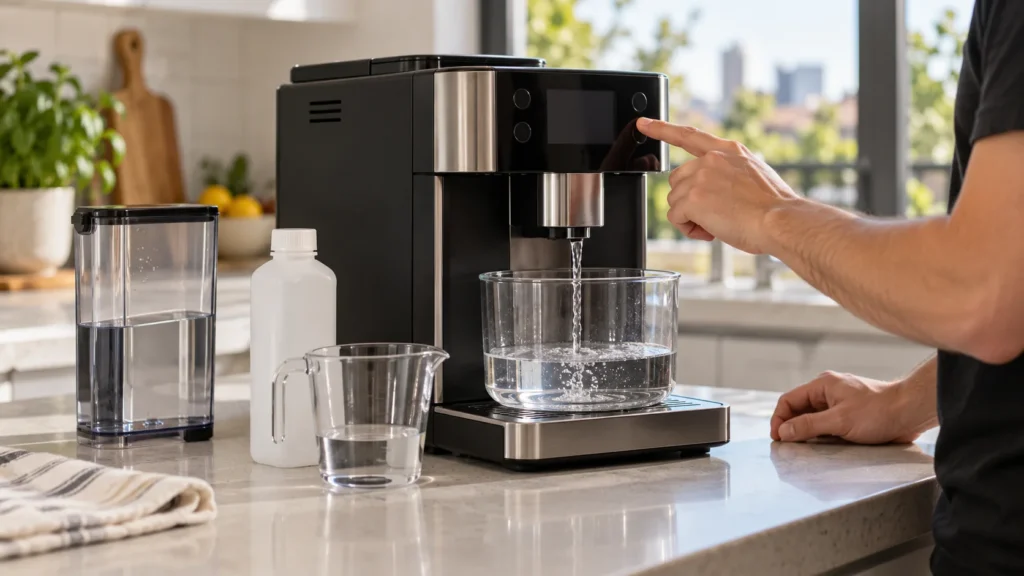
The general shape of a manufacturer descale usually includes these stages, although the order and detail differ between brands:
- Empty the drip tray and remove the water filter if one is fitted, as many manuals instruct.
- Mix the descaler with water in the tank, using the quantity the manual gives.
- Place a large container under the group head and steam wand.
- Run the descale mode, which pushes the solution through the system in stages.
- Rinse the tank and run the rinse cycle with fresh water until the machine signals it is finished.
A few cautions apply to almost every home machine:
- Use a descaler made for coffee machines. Many manufacturers advise against vinegar because it can be harsh on seals and internal parts, may not dissolve scale effectively and can leave a taste behind. Household descalers for kettles, dishwashers or washing machines are not the same product.
- Use the brand’s recommended descaler where there is one. Some manufacturers make their warranty conditional on descaling at the set interval with an approved product.
- Treat boiler machines with extra care. On traditional espresso machines with a heat exchanger or dual boiler, some manufacturers advise against home descaling, because loosened scale can lodge in valves. For these machines, prevention with the right water filter, and descaling by a technician when needed, is usually the safer route.
Descaling Automatic Bean-to-Cup Machines
Automatic bean-to-cup machines, also called superautomatic machines, almost always have a built-in descale program, and that program should be used every time. Brands such as Jura, De’Longhi, Bosch, Siemens and Saeco each design their own sequence, and the machine will normally track water use and prompt you when a descale is due.
Follow the on-screen steps exactly. The program typically asks you to empty the drip tray and grounds container, remove the water filter, add the descaler to the tank, place a container under the outlets and then wait while it runs the solution and the rinse cycles. Interrupting it part way, or switching the machine off mid cycle, can leave descaler inside the system, and some machines will not let you make coffee until the program is completed.
The descaler matters here too. Each manufacturer specifies a product or a type and a dose for its machines. Bosch and Siemens bean-to-cup machines, for example, have their own descaling tablets and liquid, and De’Longhi recommends its own descaler for its machines. A product made for one brand is not automatically suitable for another, so check the manual before you buy.
For a busy workplace machine, descaling is usually part of the scheduled service rather than a job for staff. On plumbed-in office and café machines, scale is normally managed with an inline filter on the water supply, and descaling is carried out by a technician as part of servicing.
From the Panica shop: De’Longhi EcoDecalk descaler, Bosch liquid descaler, Bosch 2-in-1 descaling tablets, Lujo Clean cleaning tablets (for coffee oils, not scale), Brita Purity C Quell ST scale filter, water filters and the full range of coffee machine cleaning products.
When to Follow Manufacturer Instructions or Seek Professional Service
Follow the manufacturer’s instructions for every routine descale. The manual knows your machine’s materials, its heater and its valves, and the descale program is designed around them.
Book a technician instead of descaling yourself when:
- The descale cycle stops part way, fails, or will not start.
- The descale warning or a scale error stays on after a completed cycle.
- Water barely flows, or not at all, even after descaling.
- The machine leaks, makes unusual noises or trips the power.
- It is a boiler espresso machine and the manual does not cover home descaling.
Heavy scale can need parts dismantled and cleaned, or valves and seals replaced, which is workshop work. If a descale cycle fails or the machine shows scale errors, bring it to our Caulfield South workshop. For home machines, customers drop the machine off at the workshop. For commercial machines, our technicians come on site when booked. Details are on our coffee machine repair and servicing page.
Need Help With a Machine That Will Not Descale?
Tell Panica Coffee the brand and model of your machine and what it is doing. We can recommend the right descaler or water filter, or arrange a repair at our Caulfield South workshop. For a faster answer, call us on 1300 529 505.
Frequently Asked Questions
How often should I descale my coffee machine?
As often as your manufacturer recommends, or when the machine prompts you. The interval depends on the machine, how much it is used and the water going into it. A water filter usually extends the time between descales.
Can I use vinegar to descale a coffee machine?
Many manufacturers advise against it. Vinegar can be harsh on seals and internal parts, may not dissolve scale effectively and can leave a taste behind. Use the descaler your manual recommends.
Is descaling the same as cleaning a coffee machine?
No. Cleaning removes coffee oils and milk residue with a detergent such as a cleaning tablet. Descaling removes mineral deposits from the water system with a descaler. Most machines need both, on different schedules.
Do I still need to descale if I use a water filter?
Usually yes, though less often. A filter reduces scale, but it does not remove it completely and it only works while the cartridge is changed on schedule. Some manufacturers adjust the descale interval when their own filter is fitted, so check the manual.
What should I do if the descale cycle fails?
Stop, rinse the tank and run fresh water through if the machine allows it, then have the machine checked. A failed cycle or a scale error that will not clear often means a blockage or a faulty part. Bring a home machine to our Caulfield South workshop, or book a technician for a commercial machine.
Keep Your Machine Running Well
Descale with the right product when your machine asks, clean it on its own schedule and fit a suitable water filter. If anything goes wrong, Panica Coffee can help.