
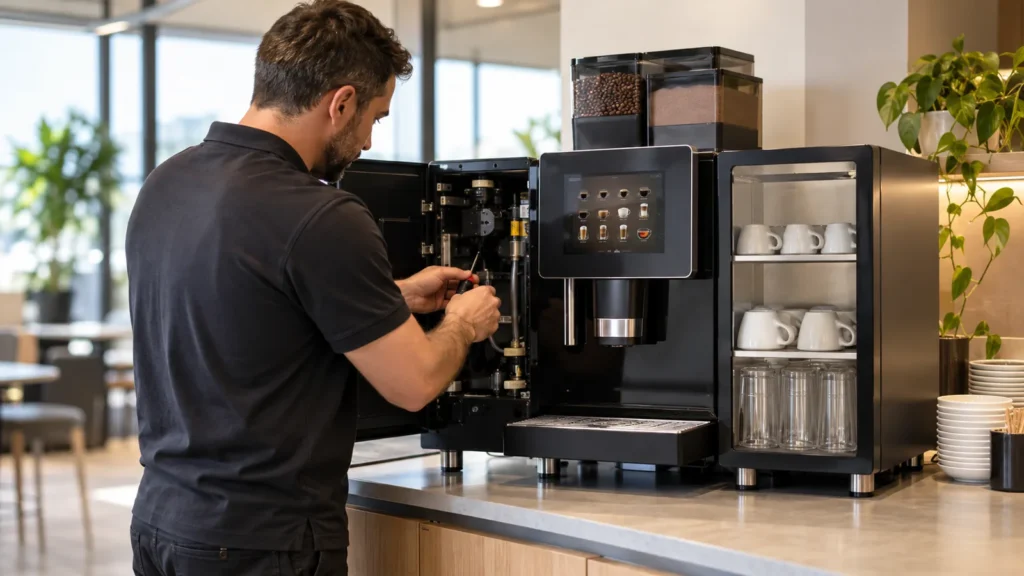
A commercial coffee machine that stops mid-morning needs sorting today, not next week. Most faults, however, trace back to a short list of causes. Blocked grounds, a starved water supply, scale, a dirty milk circuit or a lockout message on the screen cover a large share of callouts. Panica Coffee repairs and services commercial superautomatic coffee machines across Melbourne, and some of what we attend can be checked safely on site first. This guide sets out the faults we see most often, the checks your team can make in a few minutes, and the point where the machine genuinely needs a technician.
Why Does One Symptom Have Several Possible Causes?
A commercial superautomatic coffee machine holds a grinder, a brew unit, a boiler and a milk system inside one body. Each of those parts can fail on its own. Therefore the same symptom, such as a weak coffee, can point to three or four different problems.
That matters when you report a fault. The more precisely you describe what the machine does, the faster a technician can arrive with the right part. For example, no coffee at all and a coffee that pours only a trickle are different faults with different fixes.
The Faults We See Most, and What They Usually Mean
The table below covers the eight faults behind most commercial coffee machine repairs in Melbourne workplaces.
| Symptom | Most likely causes | Safe check on site |
|---|---|---|
| Screen is blank and nothing responds | Power supply, tripped circuit, machine switched off at the wall | Check the outlet, the switch and the switchboard |
| Machine will not start a drink and shows a message | Grounds container or drip tray not seated, door ajar, service lockout | Empty the grounds, then reseat every removable part |
| Grinder runs but no coffee arrives | Empty hopper, hopper slide closed, bridged or oily beans, grind too fine | Check the beans and the hopper slide, then coarsen the grind |
| Coffee pours as a trickle, or tastes weak and watery | Grind setting, dose, a blocked brew unit, scale in the group | Run the cleaning cycle, then adjust the grind one step |
| Milk drinks come out cold, thin or not at all | Milk circuit not cleaned, blocked milk line, air leak, container seated wrong | Run the milk clean, reseat the container, check the tube |
| Water pooling under or behind the machine | Full drip tray, split hose, loose filter fitting, internal seal | Empty the tray, then find the source before the machine is moved |
| Descale or filter message, machine locked out | Scale build up, filter past its service life, counter not reset | Confirm the filter age, and do not bypass the message |
| Drinks slow down or drop out through the morning | Boiler recovery under load, restricted water supply, scale, undersized machine | Check the mains tap is fully open and the filter is current |
Not sure whether your machine needs a repair or a bigger machine? Panica Coffee can look at the fault history, your daily cup numbers and the machine you are running, then advise which of the two you are actually dealing with.
What Can Your Team Safely Check First?
Four checks resolve a useful share of faults, and all four are safe for staff to do. Work through them in order before you book a repair.
- Power and water. Confirm the machine is switched on, the circuit has not tripped, and the mains tap behind the machine is fully open. Tank fed machines need the tank filled and seated properly.
- Empty everything. Remove the grounds container and the drip tray, empty both, then refit them firmly. Many machines lock out simply because a part is not seated.
- Run the cleaning cycles. Use the machine’s own cleaning and milk rinse programs, with the correct tablets or detergent. A dirty brew unit and a dirty milk circuit cause a surprising number of reported faults.
- Check the beans and the grind. Old or oily beans bridge in the hopper and choke the grinder. In addition, a grind that has drifted too fine will throttle the flow.
If the machine works normally after those checks, log what you found. Consequently, if the same fault returns within a week, the technician has useful history to work from.
What You Should Not Attempt
Safety comes before uptime here. A commercial machine holds hot water under pressure and runs on a heavy electrical circuit, so some work belongs to a technician only.
- Do not open the machine panels or casing.
- Do not dismantle the brew unit beyond the removal the manual describes.
- Do not work on the machine while it is hot or still powered.
- Do not descale with vinegar or a household product, because the wrong chemical can damage seals and boilers.
- Do not bypass an error to keep trading, since the message is usually protecting the machine.
- Do not touch mains plumbing or electrical connections.
When Does a Commercial Coffee Machine Need a Technician?
Call a technician when the fault is internal, electrical, under pressure, or returns after a reset. Those four signs mean the machine needs someone with parts and test equipment.
- Water appears from inside the machine rather than from a full tray.
- The machine trips the circuit, smells hot, or will not power up.
- An error code comes back after the machine has been restarted.
- The grinder makes a metallic or grinding noise.
- Milk drinks are still wrong after a full clean of the milk circuit.
- Steam or hot water arrives when nothing was requested.
Panica Coffee services and repairs commercial superautomatic coffee machines from a workshop in Caulfield South and on site across Melbourne. Where a fault stops a business trading, our emergency coffee machine repairs in Melbourne page explains how to get it looked at quickly, and you can book a coffee machine repair directly.
How Do You Avoid Most Repair Callouts?
Most repair callouts are preventable, and the prevention is routine rather than technical. Three habits do the heavy lifting.
First, clean the milk system every day the machine is used. Our guide to the daily office coffee machine cleaning routine sets out what that takes in practice. Second, change the water filter on schedule instead of waiting for the message, because scale does its damage quietly. Our guide to water filtration for commercial coffee machines explains what that filter protects.
Third, keep the machine on scheduled preventative servicing rather than calling only when it fails. A serviced machine has its seals, group and milk system checked before they cause a stoppage. See what is included in an office coffee machine service plan for the detail.
Repair or Replace an Ageing Machine?
Repair a machine that runs reliably between faults and still suits your cup numbers. Reconsider the machine when repairs become repeat visits, when parts are getting hard to source, or when the workplace has outgrown it.
A machine that fails under load every busy morning is often the wrong size rather than broken. In that case a repair fixes the symptom and the queue returns. Because rental includes servicing, some businesses move to office coffee machine rental in Melbourne at that point instead of funding another repair on equipment they own outright.
Commercial Coffee Machine Repairs From Panica Coffee
Panica Coffee has rented, sold, serviced and repaired commercial coffee equipment for Melbourne businesses since 2017. We work on commercial superautomatic and bean to cup machines for offices, hospitality venues, schools, clinics and showrooms, with a 4–24 hour response for Melbourne callouts within 30 km of Caulfield South (24–48 hours further out).
For businesses that would rather not carry repair risk at all, our commercial coffee machine servicing in Melbourne page sets out the preventative option.
Need Your Coffee Machine Looked At?
Tell Panica Coffee the machine you are running, what it is doing, and whether it has stopped completely. We will advise whether it is a site check, a repair or a sizing problem. Call 1300 529 505 or send the form below.
In a building that runs 24 hours, a stoppage is felt on every shift. Our guide to coffee machines for aged care covers what that changes about placement, cleaning and cover.
From the Panica shop: coffee machine spare parts and coffee machine cleaning products.
Frequently Asked Questions
Why has my commercial coffee machine stopped working?
The most common reasons are a full grounds container, a part that is not seated, a closed water tap, a blocked brew unit or a descale lockout. Work through power, water, emptying and a cleaning cycle first. If the machine still will not run, it needs a technician.
Can I repair a commercial coffee machine myself?
You can safely check power, water, the grounds container, the beans, the grind and the cleaning cycles. You should not open the casing, dismantle the brew unit or touch plumbing and electrical connections, because a commercial machine holds hot water under pressure.
How quickly can a coffee machine be repaired in Melbourne?
Panica Coffee offers a 4–24 hour response for Melbourne businesses within 30 km of Caulfield South (24–48 hours further out). How quickly the machine returns to service depends on the fault and the part, so describe the symptom precisely when you report it.
Why is my coffee machine leaking water?
A full drip tray is the usual cause and the easiest to rule out. Water from inside the machine points to a split hose, a loose filter fitting or a failed seal, and that needs a technician rather than a mop.
What does a descale message mean on a commercial coffee machine?
A descale message means scale has built up in the water circuit and the machine wants it removed. Do not bypass it, and do not use a household product. Scale restricts flow, strains the boiler and eventually causes a bigger repair.
Is it worth repairing an older commercial coffee machine?
It is worth repairing while the machine runs reliably between faults and still handles your daily cup numbers. Once repairs become repeat visits, or the machine struggles every busy morning, compare the cost against a serviced rental machine.
Machine Down Now?
Call Panica Coffee on 1300 529 505 with the make, the model and what the screen is showing. We can tell you whether one more check on site is worth trying, or whether a technician should come out.